FYP25109: A transparent blockchain and AI-based course review platform with an internal token economy.
Student: FAIAZ Mahir [3035918696]
Supervisor: Prof. Yiu Siu Ming
Project Webpage
Welcome to the FYP25109 Project Webpage!
About the Project
Course selection at universities is one of the highest-stakes decisions a student makes each semester, yet the information available to inform that decision is unreliable. Students rely on word-of-mouth, scattered group chats, and ad-hoc spreadsheets passed between cohorts. The few existing review platforms suffer from three structural problems:
- No accountability for what gets removed. A platform administrator or course instructor can silently delete an unflattering review and nobody — not the author, not future readers — has any way to detect that the deletion happened.
- No quality control on what gets posted. Anonymous platforms fill up with one-word reviews, personal attacks, copy-pasted spam, and off-topic rants, drowning out the substantive feedback students actually need.
- No incentive to contribute. The students with the most useful information to share — those who have just finished a course — have no reason to spend twenty minutes writing a careful review for the benefit of strangers. Free-riders read; almost nobody writes.
This project addresses each of these problems with a specific technical mechanism, described in the “Main Features” section below.
Main Features
AI-powered semantic search (“friendly professor”, “low workload”)
→ Solves the discovery problem: students rarely know the exact course code they want. The platform embeds every confirmed review with all-MiniLM-L6-v2 and matches natural-language queries against that embedding space, so a search for “supportive instructor” surfaces courses whose reviewers used phrases like “approachable”, “patient”, and “answers questions” — not just courses with the literal word “supportive” in their title.
Internal token economy: write +4, read -1
→ Solves the free-rider problem. New users receive 3 tokens after HKU email verification — enough to read three courses’ reviews before they must contribute. Submitting a confirmed review earns 4tokens, supporting four further reads. The result is a near-neutral steady state in which exploration is funded by participation, and the most engaged users (those who write reviews) gain the most access to others’ insights.
Tamper-evident reviews anchored on Hyperledger Fabric 2.5.9
→ Solves the silent-deletion problem. Every confirmed review’s SHA-256 hash is written to the Fabric ledger at submission time. If an admin later removes or edits the review in the database, the on-chain hash no longer matches, and an integrity check detects the discrepancy. Moderation actions (flag, restore, appeal-approve) are themselves appended to the chain as an immutable audit trail, so the platform’s behaviour is externally verifiable.
Three-tier AI community standards pipeline
→ Solves the quality-control problem. Every submission is run through three independent checks: language quality (word count, gibberish detection, repetition), toxicity (six-category classification via unitary/toxic-bert), and spam/duplicate detection (cosine similarity against existing reviews for the same course). Clearviolations are rejected outright; grey-zone submissions are held for admin review; clean submissions are published automatically. This filters noise without slowing down good-faith contributors.
Experience Score: AI-generated 5-class sentiment label
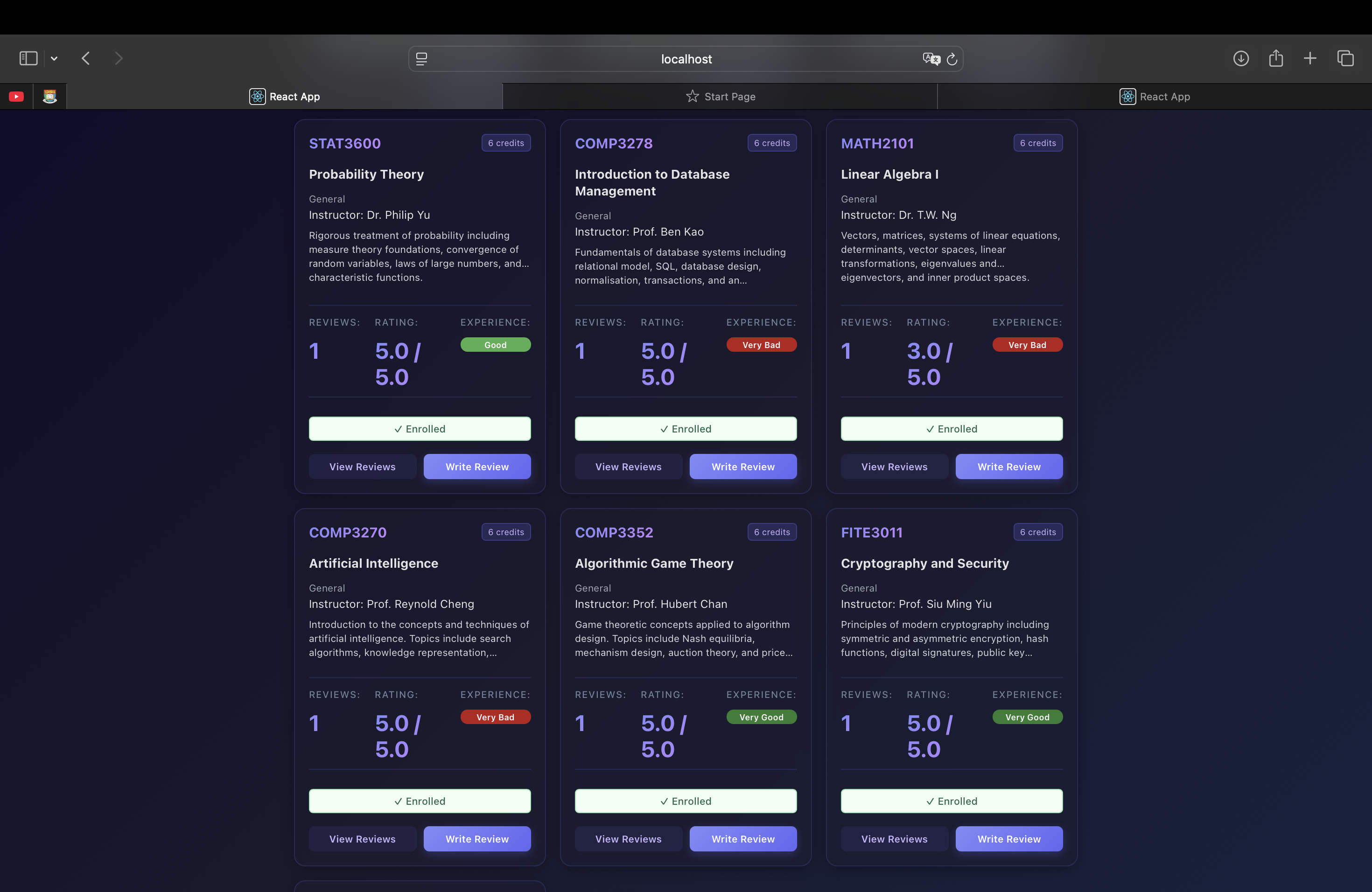
→ Solves the rating-comparison problem. Traditional 5-star averages hide the texture of student opinion: a course averaging 3.2 stars could be uniformly mediocre or wildly polarising, and the number tells you nothing. Each review’s free-text comment is classified by a fine-tuned DistilBERT model (F1 = 91.32% on IMDB 50K) into one of five labels — Very Bad, Bad, Neutral, Good, Very Good — and eachcourse displays the aggregate alongside the star rating, giving prospective students a quick read on whether reviewers’ words match their numbers.
Admin moderation queues: pending, flagged, appeals
→ Solves the dispute-resolution problem. The three-tier AI pipelineis not infallible, so the admin panel exposes three queues. Users whose reviews are flagged or held pending can file a written appeal, which surfaces in the Appeals tab for human review. Every moderation decision — and every reversal — is anchored on the blockchain, so the moderation process itself remains auditable.
Documents
Following are the three documents produced was the project progressed.
Application UI
Following are some screenshots of the platform’s UI